
Health and safety online course

Concrete, cement and mortar: skin, dust and pours

Concrete, cement and mortar training for everyone who mixes, lays or finishes it

£22.50 a place, the whole price

This is PHW training with a certificate of completion. It is not an accredited qualification, so it is for you to decide whether it is enough for your business.

Each person does the course on their own phone, passes a test that is marked automatically, and gets a certificate with a QR code that anyone can scan to check. You see who has passed. £22.50 a place.

About 30 minutes on a phone, tablet or computer. Test marked by the system.

What gets asked for. A serious cement burn can take months to heal, HSE says, and in extreme cases may need a skin graft. An inspector, an insurer or a customer's auditor can ask what training your people have had, and what you can show for it.

Who it is for

  • Bricklayers and their labourers
  • Groundworkers and concrete gangs
  • Floor layers and screeders
  • Paviors, landscapers and fencers who set posts in concrete
  • Anyone who works around a concrete pour: formwork and falsework gangs, and the people who place concrete from a pump
What it covers
  • What wet cement does to skin and eyes, and where it gets trapped
  • What COSHH asks of the employer and of the worker
  • Gloves, boots, trousers over the boots, and knee protection
  • Washing at once, cement inside a glove or boot, and first aid for an eye splash
  • Irritant and allergic dermatitis, the date on the bag, skin checks and reporting
  • Cement dust, silica from cutting concrete and mortar, and handling bags
  • Formwork and falsework: why nobody goes under the formwork during a pour
  • Concrete pumps: the danger zone round the hose, and never opening a line under pressure

How it works

  1. Buy places. Pay by card. Your order page is ready as soon as the payment goes through.
  2. Send the join link to your staff. One link covers everyone. Each person types their name and starts.
  3. They do the lessons on their own phone. It takes about 30 minutes in all, and they can stop and carry on later.
  4. They sit the test. It is marked by the system. Anyone who misses is told which lessons to read again. After a miss there is a wait before the next try, and after six tries in a row the lessons are read again.
  5. A pass gives a certificate. It has a QR code anyone can scan to check it, and your order page links to every one.
  6. You sign off the practical. Each certificate comes with a sign-off sheet. You watch the person do the job on your own equipment, tick each check and sign. The online course teaches the knowledge. You decide who is authorised to do the work.
The law behind it
  • Employers have to provide suitable and sufficient information, instruction and training to employees whose work is liable to expose them to a substance hazardous to health. Source: legislation.gov.uk
  • HSE says cement is a hazardous substance, and that wet cement burns can be severe because it is highly alkaline. Source: hse.gov.uk
  • HSE says a serious burn or ulcer can develop rapidly if wet cement is trapped against the skin, and in extreme cases may need a skin graft or lead to amputation. Source: hse.gov.uk
  • HSE says some skilled tradesmen have been forced to change their trade because of allergic dermatitis from cement. Source: hse.gov.uk
  • Employers have to provide suitable protective equipment unless the risk is already adequately controlled by other means. Source: legislation.gov.uk
  • On a construction site, washing facilities must include hot and cold or warm water, soap or another suitable means of cleaning, and towels or another means of drying. Source: legislation.gov.uk
  • Employers have to arrange suitable health surveillance where it is appropriate for the protection of employees exposed to a hazardous substance. Source: legislation.gov.uk

What you get

  • The online course for each place you buy: nine short lessons and a test
  • A certificate for each person who passes, with a QR code anyone can scan to check it
  • A page for you showing who has taken the course and who has passed
  • A sign-off sheet for each person: things you watch them do on your own site and tick off, with a place to authorise them in writing

£22.50 a place is the whole price. It costs the same for one place or fifty.

The lessons

  1. What wet cement does to skin and eyes3 min
  2. What your boss has to provide, and what you have to do3 min
  3. Gloves, boots, trousers and knees4 min
  4. Wash it off now, and what to do in an eye splash3 min
  5. Dermatitis, the date on the bag and skin checks3 min
  6. Dust, silica and cement bags4 min
  7. Formwork and falsework: keep out from under the pour3 min
  8. Concrete pumps: the danger zone and blockages4 min
  9. Putting it together, and your sign-off3 min

Read the first lesson free

Free preview

What wet cement does to skin and eyes

It is a strong alkali

Wet cement is highly alkaline. HSE gives its pH as 12 to 13. That is a strong alkali, and it burns.

A serious burn or ulcer can develop rapidly when wet cement is trapped against your skin. These burns often take months to heal. In extreme cases they need a skin graft, and some have led to amputation.
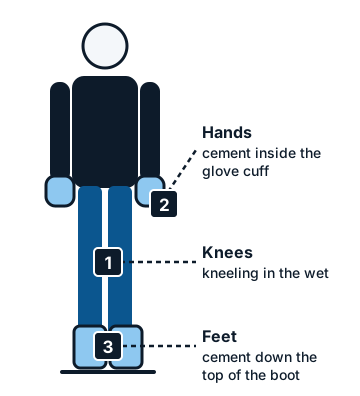
Where it gets trapped

A worker with three numbered points marked. One, the knees, from kneeling in wet cement. Two, the hands, where cement gets inside the glove cuff. Three, the feet, where cement runs down the top of the boot.

A splash that runs straight off is one thing. Cement held against the skin is another. That happens in three places.

  • Your knees, when you kneel in it and it soaks through your trousers.
  • Your hands, when it gets down inside the cuff of a glove.
  • Your feet, when it runs over the top of a boot.
Do not wait. Wash cement off as soon as you can.

Your eyes

Cement can also burn your eyes. It can cause chemical burns to the eyes. Lesson 4 covers what to do.

Over the years

Cement causes dermatitis too, and one kind can end a career in the trade. Lesson 5 covers it.

How this course works

Nine short lessons, each with a practice question, then a test that marks itself. You can do it a bit at a time on your phone.

Practice question

Where does wet cement do the worst damage?

Questions

How long does it take?

About 30 minutes in all: nine short lessons, then a 15-question test. You can stop and carry on later, so it fits into a break.

What about self-employed labourers?

Buy them a place the same as anyone else. They take the course on their own phone and get their own certificate. You watch them on your site and sign the sheet the same as for your own staff.

How often should it be repeated?

The certificate has no expiry date on it. How often your people repeat the course is for you to decide in your own risk assessment.

What is the certificate?

It says the person completed the online concrete, cement and mortar course and passed the test. It lists what the course covered and carries a QR code and a certificate number. It is training evidence you can put on file and show to anyone who asks.

How does the practical part work?

The online course is the training. The practical is done on your own site: you watch the person fit their gloves, wear their trousers over their boots, find the washing facilities and eyewash, and work through the checks on the sign-off sheet. When everything is right, you authorise them in writing for the work they may do.

Can staff do it on a phone?

Yes. The lessons, pictures, practice questions and test all work in the phone's browser, and the lessons are short enough to fit into a break.

How can anyone check a certificate?

Scan the QR code on it. It opens a page that confirms the certificate is genuine and who holds it, so an inspector, an insurer or a customer's auditor can see it is real.

What happens if someone fails the test?

They are told which lessons to re-read, and they can retake the test straight away. Each retake draws a fresh set of questions. There is no limit on retakes.

What if someone loses their link?

They can ask for it again by email on the "Lost my link" page, as long as they gave an email address when they started.

Ready?

£22.50 a place, the whole price

This is PHW training with a certificate of completion. It is not an accredited qualification, so it is for you to decide whether it is enough for your business.