
Health and safety online course

Manual handling

Manual handling training for everyone who lifts, carries, pushes or pulls

£22.50 a place, the whole price

This is PHW training with a certificate of completion. It is not an accredited qualification, so it is for you to decide whether it is enough for your business.

You pay for the places you need and get one link to send to your staff. Each person opens it on their own phone and does the course. They sit a test marked online, and when they pass they get a certificate with a QR code that anyone can scan to check it. You see who has passed. The online part teaches the method and tests it. The practical part is you watching each person lift on your own site, with a sheet of twelve checks to tick. £22.50 a place.

About 30 minutes on a phone, tablet or computer. Test marked by the system.

What gets asked for. When someone is hurt at work, HSE's guide to investigating accidents asks whether the training was delivered and whether training records were kept. Each certificate is your dated record that the person did the online part.

Who it is for

  • Warehouse and goods-in staff
  • Labourers and site crews
  • Fitters and tradespeople who carry kit and materials
  • Cellar, stockroom and delivery staff
  • Anyone whose job involves lifting, carrying, pushing or pulling a load
What it covers
  • Avoid, assess, reduce: what the Manual Handling Operations Regulations ask of an employer
  • Avoiding the handling: aids, delivery to point of use and smaller loads
  • Assessing a job with TILE: task, individual, load and environment
  • How HSE's guideline figures work, and what changes what a person can safely handle
  • Testing a load and planning the route before a lift
  • Safe lifting, putting down, turning with the feet, and awkward shapes
  • Carrying, pushing, pulling and team lifts
  • Reporting pain early, and the employer's part in training and practical sign-off

How it works

  1. Buy places. Pay by card. Your order page is ready as soon as the payment goes through.
  2. Send the join link to your staff. One link covers everyone. Each person types their name and starts.
  3. They do the lessons on their own phone. It takes about 30 minutes in all, and they can stop and carry on later.
  4. They sit the test. It is marked by the system. Anyone who misses is told which lessons to read again. After a miss there is a wait before the next try, and after six tries in a row the lessons are read again.
  5. A pass gives a certificate. It has a QR code anyone can scan to check it, and your order page links to every one.
  6. You sign off the practical. Each certificate comes with a sign-off sheet. You watch the person do the job on your own equipment, tick each check and sign. The online course teaches the knowledge. You decide who is authorised to do the work.
The law behind it
  • Employers have to avoid manual handling that risks injury, so far as is reasonably practicable. What cannot be avoided has to be assessed, and the risk of injury reduced to the lowest level reasonably practicable. Source: legislation.gov.uk
  • Employers have to give employees health and safety training when they start and when risks change. It has to be repeated periodically where appropriate, and take place during working hours. Source: legislation.gov.uk
  • HSE guidance, not law: training on its own will not ensure safe manual handling, and training should include practical work so the trainer can put right anything unsafe. Source: hse.gov.uk
  • An employer with five or more employees has to record the significant findings of the risk assessment. Source: legislation.gov.uk

What you get

  • The online course for each place you buy: eight short lessons and a test, with one link to send to your staff
  • A certificate for each person who passes, with a QR code anyone can scan to check it
  • A page for you showing who has taken the course and who has passed
  • The practical sign-off sheet: twelve checks you watch the person do on your own site, with your own loads and equipment, and your written authorisation

£22.50 a place is the whole price. It costs the same for one place or fifty.

The lessons

  1. What your boss has to do, and what you do4 min
  2. Avoid it: the best lift is the one you do not do3 min
  3. Look at the job: task, individual, load, environment4 min
  4. Guideline figures and your own limits5 min
  5. Before you lift: test it and plan it3 min
  6. How to lift and put down5 min
  7. Carrying, pushing, pulling and team lifts3 min
  8. Speak up early, and what your boss still has to do3 min

Read the first lesson free

Free preview

What your boss has to do, and what you do

Think of the last heavy thing you carried. Could a trolley have done it? That is the first question this course teaches.

Your boss has sent you this because you lift, carry, push or pull things at work. By the end you will know how to spot a lift that could hurt you, and how to lift when you cannot avoid it.

Your boss should let you do this in work time. If you are doing it at home, tell your boss.

What counts as manual handling

Manual handling is lifting, putting down, pushing, pulling, carrying or moving a load with your hands or your body. A load can be a box or a sack. It can be a loaded roll cage or pallet truck that you push. It can be a person or an animal.

What the law asks of your boss

The Manual Handling Operations Regulations set an order. First, your boss has to try to stop any handling that could injure someone from being needed at all. They can skip that only if the cost and effort would be far out of proportion to the risk. If it cannot be avoided, they have to assess it. Then they have to make the risk as small as they reasonably can.
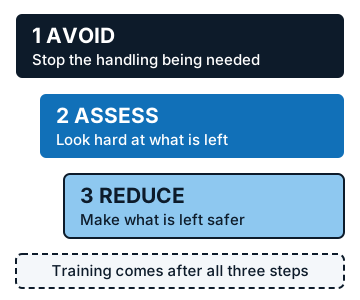
Three steps in order. One: avoid, stop the handling being needed. Two: assess, look hard at what is left. Three: reduce, make what is left safer. Training comes after all three.
Avoid first. Then assess. Then reduce. That is the order.

Where training fits

Training does not replace the other steps. HSE, the Health and Safety Executive, says training on its own will not make manual handling safe.

This course is the training part. It teaches you the rules and the method. At the end there is a test of 15 questions. You need at least 12 right. If you miss, the course tells you which lessons to read again and you can retake it straight away.

Where you come in

You have duties too. Use the kit and the way of working your boss gives you, and use them properly. Look after your own safety and the safety of anyone your work could hurt.

You also have to tell your boss when you spot a handling job that could hurt someone. HSE also says to tell them when things change.

Practice question

What is the first thing your boss has to try?

Questions

How long does it take?

About half an hour in all, test included. It is eight short lessons, a practice question in each, and a test of 15 questions.

What is the certificate?

It says the person completed the online manual handling course and passed the test. It lists what the course covered and carries a QR code and a certificate number. It is training evidence you can put on file and show to anyone who asks.

How does the practical part work?

Once someone has passed, you watch them handle real loads from your own site and tick off the checks on the practical sign-off sheet. When every check is ticked, you sign to authorise them in writing for that work. The online course teaches the rules and the method. The practical on your own loads and equipment is assessed and authorised by you.

Can staff do it on a phone?

Yes. The course and the test are made for a phone screen. They need a mobile signal or wifi, because the test is marked online. Health and safety training has to take place during working hours, so let people do it on the clock.

How can anyone check a certificate?

Scan the QR code on the certificate. It opens a page that confirms the certificate is genuine.

What happens if someone fails?

They can retake the test straight away, as many times as they need. Each go uses a fresh set of questions. After a fail the course points them back to the lessons to read again.

How often do people redo it?

The regulations do not set a fixed gap. Health and safety training has to be given when someone starts, when something new or riskier comes in, and repeated from time to time where appropriate.

Is there a legal weight limit?

No. The law sets no weight limits. HSE publishes guideline figures, and the course gives them and explains how to use them.

What if someone loses their link?

They can ask for it again by email on the "Lost my link" page, as long as they gave an email address when they started.

Ready?

£22.50 a place, the whole price

This is PHW training with a certificate of completion. It is not an accredited qualification, so it is for you to decide whether it is enough for your business.