
Train the people who guide your reversing vehicles. £22.50 a place.
This is PHW training with a certificate of completion. It is not an accredited qualification, so it is for you to decide whether it is enough for your business.
Your staff do the course on their own phones, about 33 minutes of lessons, then a test marked for them. They get a certificate with a QR code that anyone can scan to check. You get a page that lists who has passed. You watch each person marshal a real vehicle on your own site and sign them off on the sheet we give you.
£22.50 a place is the whole price. It costs the same for one place or fifty.
A lorry backing on to a bay is slow and it beeps, so it does not look dangerous. The driver still cannot see behind it.
The Health and Safety Executive (HSE) counts the people killed at work in Great Britain. So far in 2025/26 (the figures are not final), 24 workers were killed after being hit by a moving vehicle. Only falls from a height killed more, at 31.
Nearly a quarter of all deaths involving workplace transport happen while a vehicle is reversing.
On many lorries and vans the driver cannot see the space directly behind. A driver who cannot see behind should get out and look before reversing. If you are standing in that space, as far as the driver is concerned you are not there.
Some sites use a marshal to guide the driver and keep people out of the way. You will also hear banksman or signaller. It is the same job.
Banksmen suffer serious and fatal injuries every year. The job puts them close to where the vehicle is going.
A banksman is for where there is no other way to control the reversing risk. The best answer is a layout where nobody has to reverse. Lesson 2 shows how.
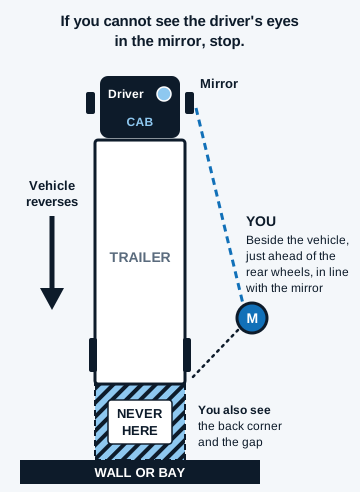
The driver has to be able to see you at all times. If you cannot see the driver's face or eyes in the mirror, treat it as lost sight. The driver may not be able to see you, so stop. Lesson 3 shows where to stand.
When should a banksman be used?
The lessons take about 33 minutes in all, nine of them at three to five minutes each, then a test of 15 questions. The pass mark is 80 percent, which is 12 right.
After you pay, you get an order page and a link for your staff. Send the link to each person. They open it, type their own name and start the course on their own phone.
Open your order page. It lists everyone who has joined, how far they have got, and who has passed and when. We email you the link to it after you pay, so keep that email.
An email address is optional. They need a phone, tablet or computer with a web browser, and the link you send them is how they get back in.
It records that the person completed the online course and passed the test, with the date and a QR code that anyone can scan to check it. It is evidence you can keep on file and show to an inspector, an insurer or a customer's auditor. The practical on your own vehicles is recorded on your sign-off sheet.
The course tells each learner plainly that they do not marshal until you have watched them do it and authorised them in writing. You use the sign-off sheet on your own site with your own vehicles, because only you know your vehicles and your layout.
Four. Nobody marshals until you have watched them and signed them off in writing. If contact is lost, the vehicle stops. Nobody overrules a marshal's stop. A vehicle with a faulty mirror, light or reversing alarm does not reverse until it is sorted. Tell your drivers and supervisors, so the site works the way the course says.
Yes. The lessons, pictures, practice questions and test all work in the phone's browser.
Scan the QR code on it. It opens a page that confirms the certificate is genuine and who holds it.
They are told which lessons to re-read and can retake the test as often as they need. Each retake draws a fresh set of questions.
They can ask for it again by email on the "Lost my link" page, as long as they gave an email address when they started.
This is PHW training with a certificate of completion. It is not an accredited qualification, so it is for you to decide whether it is enough for your business.